The Dad Project: A Follow Up
I still remember sitting down to write the first letter to my Dad — to tell him that my mom, his ex-wife, had died.
The project started a few weeks before that, at a May 2025 Chatterbox Creatives Zoom call, when I mentioned in passing that our next meeting would land on Father’s Day. I closed my laptop after we signed off, and it was like a bolt of lightning hit me: this — a long-term project about my dad — was what I’d been trying to find. That night, I wrote the first letter.
The Book Itself
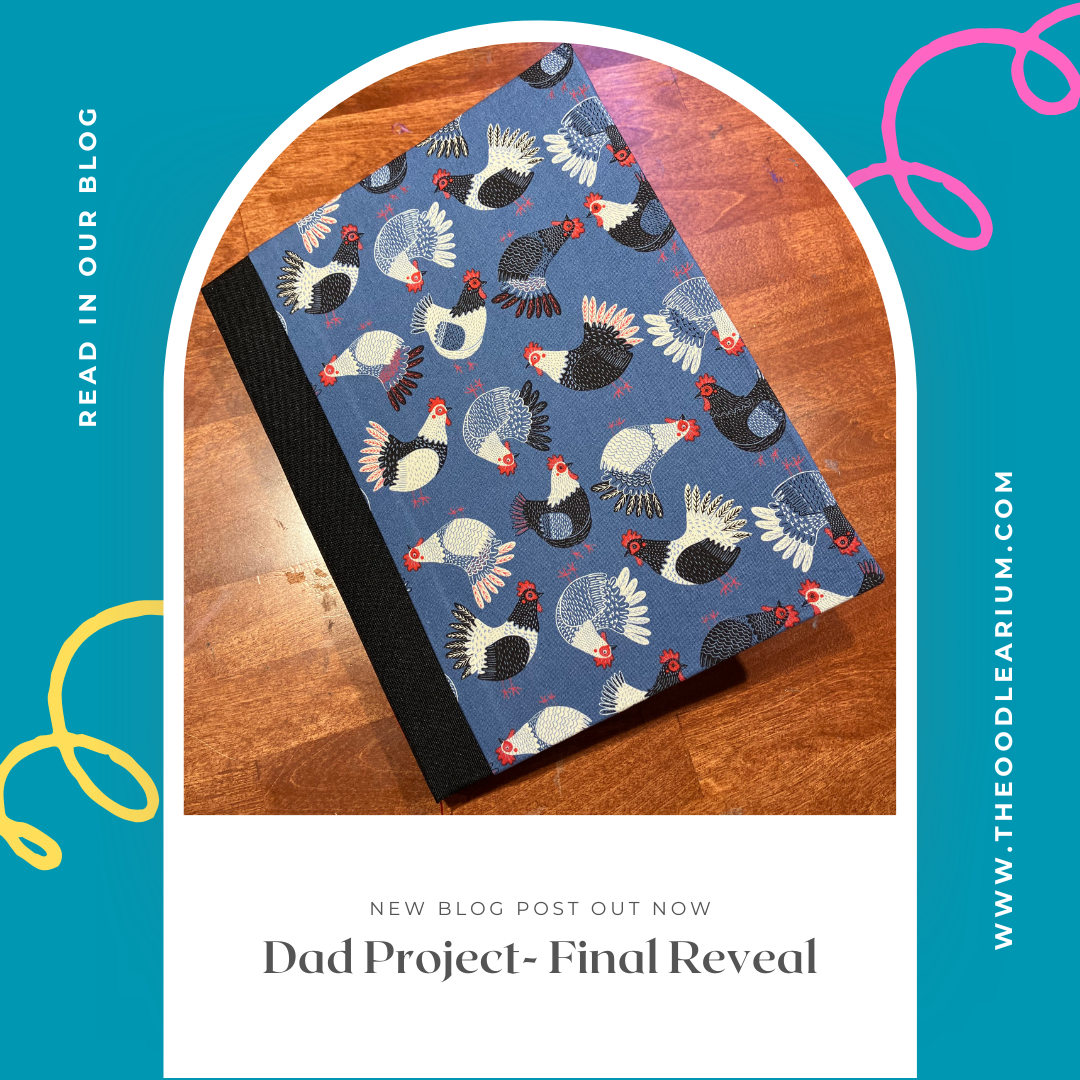
I chose fabric covered in roosters for the cover — a nod to my maiden name, Hahn, which means “rooster” in German. The binding is hand-stitched through 64 holes, each pass of the needle slow and deliberate — a meditative, almost ritual act, and one I wanted left visible rather than hidden, sewn in red thread against black cloth.
Inside the Book
It opens with a poem, Thank You, tracing who he was and how it shaped who I am, alongside a watercolor of a rooster — another Hahn nod, and a chance to share my own art with him.
The hardest pages come early: a letter dated May 29, 2025, telling him my mother had died after 21 days on a ventilator, and how the last time I’d seen her alive felt like visiting a stranger. Nearby, a poem called What I Didn’t Know moves through everything he’s missed — Cubs games, black licorice, fishing — and a collaged obituary spread tells the story of the house I grew up in, sold in 2003 for $230,000 and again decades later for $2.8 million, before being torn down for a warehouse.
A handful of poems process what he’s missed one memory at a time — fishing, chasing ambulances, the Cubs winning it all in 2016. The rawest is No Kings, moving from dread over the state of the country to the one place I still find quiet, my garden, before landing on: I’m so glad you are not alive. This would break your heart… I know it’s coming for us.
Several spreads are note cards about the people who’ve shaped my life since he’s been gone — my work sister Carrie, my oldest friends, my running family, my Arizona family, Tom — most living in pockets I can keep adding to. One gets a fuller telling: my junior-high best friend Julia Lee, who proposed a poetry challenge just as my mom died, which became exactly what I needed to process everything.
Other spreads catch him up on who I’ve become: leaving teaching, my years at PADS, a long letter about my art, and a copy of The Many Faces of Elgin, the book I wrote and dedicated to him.
Two spreads tell the fuller story of building something from nothing. The Oodlearium traces how Tom turned an unused pool table room into a custom art studio, complete with a small shrine to Dad on a repurposed step ladder. The Oodle Bus traces years of trying to sell my art and feeling defeated by it, deciding art should exist only to make people smile, and a city campaign that led to a life-sized Oodle Bus touring the downtown market and local elementary schools.
I left almost twenty pages blank at the back. This isn’t a closed story.
What This Project Meant to Me
What I didn’t expect, starting out, was how fast this project would turn anger and grief into love. That first letter was the hardest thing I wrote — but every letter, poem, and photo after it was an act of turning toward my dad instead of away from what I’d lost. By the time I was writing haikus about fishing, I wasn’t grieving on the page anymore. I was remembering him.
Fourteen years is a lot to compress into one object, and for a long time all I had were lists with no shape to hold them. What moved me forward wasn’t a better list — it was deciding to make an actual handmade book. Once I knew roughly how big it would be, the decisions started making themselves. That’s part of why I left the blank pages: this was never a closed story, and I’ll keep updating him.
When I first told my Chatterbox Creatives friends about this idea, I was anxious about what the final product would even be. They told me something I’ve come back to since: it doesn’t matter. Just start collecting what pulls at you, and trust it to become what it needs to become. You’ll know when you’re done.
If a project like this is calling to you: it can be as simple or elaborate as you need. For me, the making — the cutting, the folding, the fabric with roosters on it — was as much a part of grieving as anything I wrote. For someone else, it might be letter after letter, no art at all, or just photos. There’s no wrong way to do this. The only real instruction is to start collecting, and trust it to tell you what it wants to be.


