What a Collaborative Junk Journal Taught Me
I don’t do long-term projects. There’s a specific kind of stress they bring — like a light blinking in the corner of my mind that never quite turns off. So when I signed up for this, I wasn’t signing up for one project. I was signing up for an entire book of my own — five or six spreads, covers, inside covers — plus a single spread for each of six other women.
Back in December of 2022, I reached out to a small group of photographers from 52Frames, a weekly photo challenge I’d been part of since 2018. I wanted people to build things with — to challenge my own creative boundaries alongside people doing the same. Eight ladies said yes, and Chatterbox Creatives was born. We’ve met virtually every third Sunday since January 2023, scattered across the US and as far away as Berlin. Everything comes up in those calls — travel, AI in art, quilting, long-form writing, whatever anyone’s in the middle of.
This past January, at our third anniversary, I proposed some kind of collaborative project. Eileen suggested an altered book — she’d done something similar with another group years before, and showed us her copy: a book overflowing with pockets, layers, textures, more material than seemed possible to fit between two covers.
And we all were hooked.
The idea: everyone buys a book, picks a theme, and covers the pages with fabric, photos, collage, scraps of magazines and newspapers, whatever fits. Instead of mailing the books back and forth — too expensive, too slow with everyone this spread out — we’d share our page dimensions and mail each other inserts to build into our own copies. For my own book, that meant five or six spreads plus covers and inside covers. On top of that, a single spread for each of the other six women.
I was also starting from zero. I’d never scrapbooked. I couldn’t have named any techniques, let alone done them. But I was hungry for it — this group has shared three years of everything with each other, and I wanted in on something that would ask more of me than a weekly photo.
Everyone bought their books. Everyone picked a theme. And then I sat down to start mine — dragons, mermaids, unicorns, vampires, every image I love most — and completely froze. Not for lack of material. There was too much of it. Pockets, envelopes, tags, ephemera, staining, distressing, fabric, ticket stubs — if the genre weren’t overwhelming, the techniques were.
So I did the thing that felt like procrastination at the time: I started on everyone else’s books instead.
The others were easier than my own
Once I stopped trying to solve my own book and turned to everyone else’s, the ideas showed up fast.
For Donna’s theme — DREAM — I’d happened across a whole mess of dream-themed items in a book called A Book That Takes Its Time: An Unhurried Adventure in Creative Mindfulness, including the word DREAM spelled out in Scrabble tiles. I used the image as the seed for the page, wrote a poem, and for the first time ever used ChatGPT to generate an image that matched its imagery, then printed the poem on vellum and layered it over the photo. What I didn’t know until later: Donna is a huge Scrabble fan. The tiles found her before I knew why they should.
For Juli’s theme — nature — I chose butterflies, since I have a huge collection of butterfly photographs I’ve taken over the years. I found a site with gorgeous downloadable journal pages and used them as a base, layered one of my own butterfly photos in as background, then taught myself to fold a pocket for the first time, stuffing it with butterfly quotes and bookmarks.
For Candie’s theme — whimsy, a perfect fit for my own artwork — I used a variety of pieces from my Wanda Can Do Anything series, including a canvas of my Oodle Bus (read about that silly project here), cut apart and rebuilt on painted cardboard, paired with a wedding-gown fabric sample I’d ordered specifically for this project.
For Eileen’s pages, I had a whole plan based on ideas I’d researched ahead of time. Once I started, I scrapped it all and used a series of my Wanda illustrations instead, paired with quotes from female artists, layered over Greek-inspired scrapbook paper in flaps and pockets. Eileen has multiple books going, so I might still revisit those original ideas at some point.
Denice’s spread was different
Denice’s theme was il filo rosso — the red thread, a concept she learned about on a recent trip to Sicily. We’d been texting for weeks about her trip there, tracing her family back to a village that turned out to be not far from where my own family came from.
I built her spread around that connection — a photo of my grandparents and my two-year-old mother at Ellis Island, my grandmother at my wedding, pockets of recipes and family stories, a bookmark stitched with red thread. I lost myself in the pages, and by the end my cheeks were tear-stained.
Something that had started as a simple project to celebrate our group’s anniversary quickly became a symbol of the incredibly special connection we all have with one another through this project.
Back to my own book
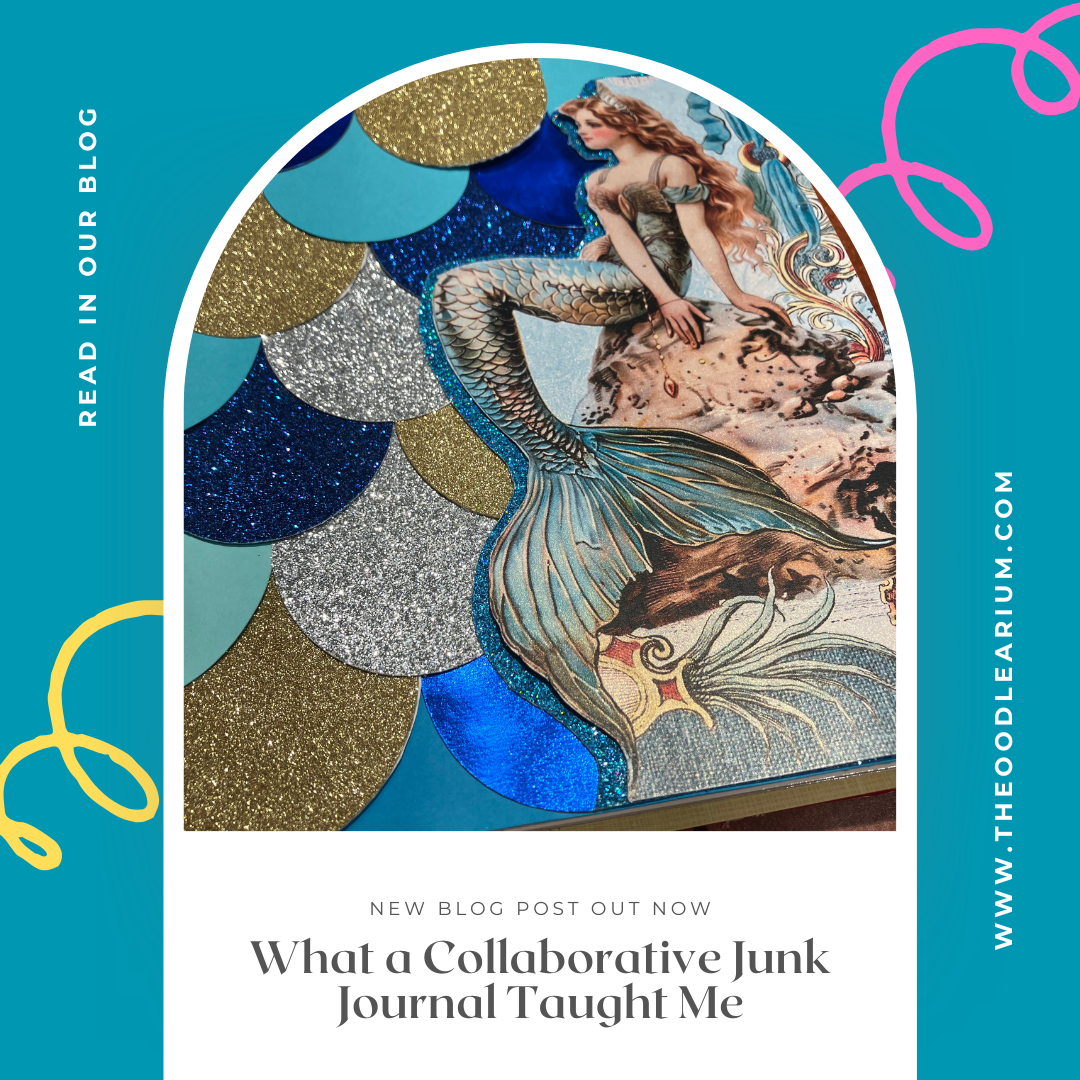
By the time I circled back to my own pages, I wasn’t starting from scratch anymore. I built on the ideas I’d used for everyone else’s pages and explored even more. I learned a pop-up mechanism to create a dragon spread, taught myself to cut mermaid scales on my Cricut, and layered a mermaid image over them. I printed a poem on vellum and mounted it over a wallpaper sample that looked like waves — a sample that turned out to be a fold-out I hadn’t noticed when I bought it. So now there’s a bonus page in my mermaid spread I didn’t plan for and wouldn’t have thought to include on purpose.
Where I am now
I’m in the middle of the vampire spread, and it’s the hardest one so far. I started with a list of almost 400 vampire-related words and have been whittling it down to write a villanelle — nineteen lines, two repeating refrains, a rhyme scheme that fights you the whole way. I haven’t figured out how I’ll display it yet. I’m still inside this one.
It’s still blinking. It’s just not so loud anymore.
Check out this 52Frames post from Eileen about the project.


